MindBlitz
What is in the test
The questions start easy and get hard, and harder questions count for more.
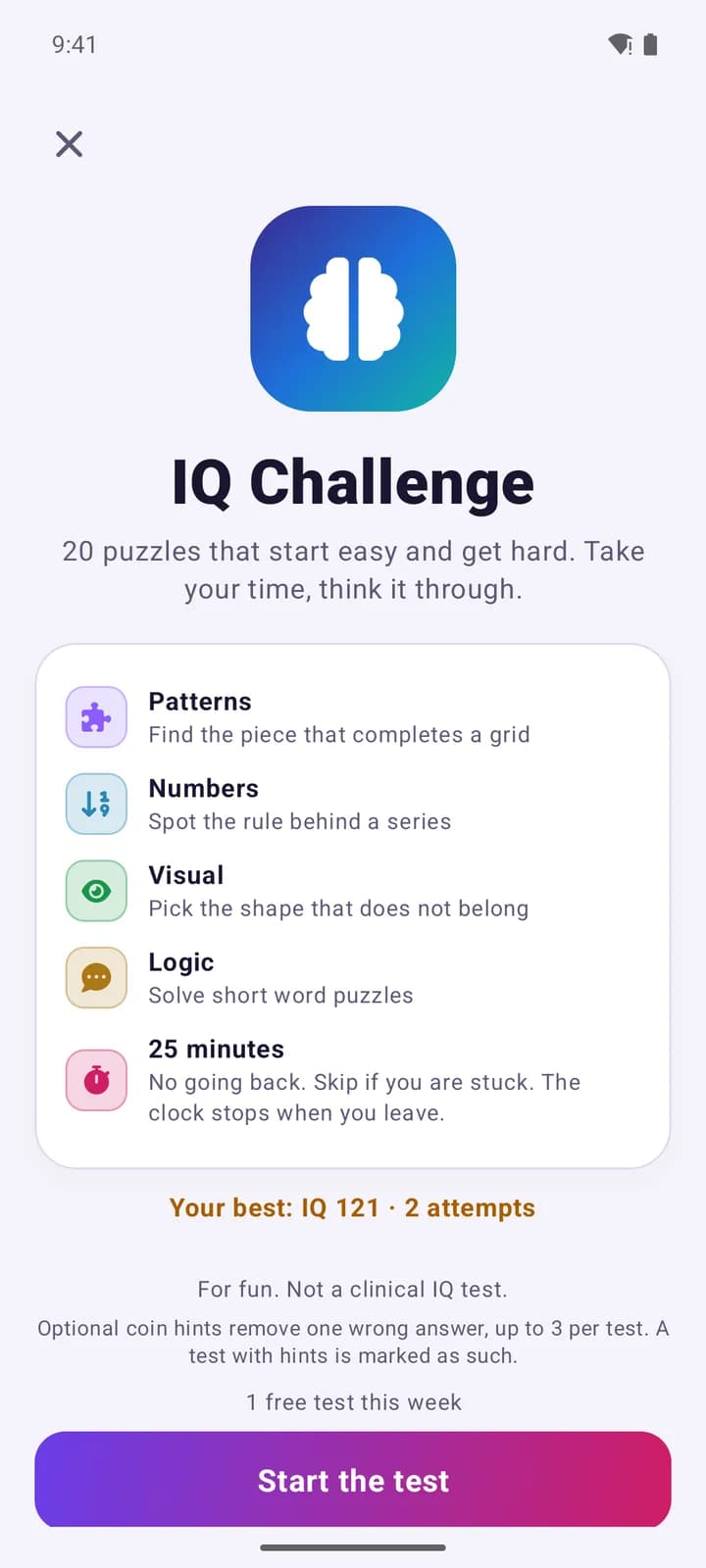
- Patterns: find the piece that completes a grid.
- Numbers: spot the rule behind a series.
- Visual: pick the shape that does not belong.
- Logic: solve short word puzzles.
How it works
- 20 questions and 25 minutes, about 75 seconds a question.
- No going back. Skip a question if you are stuck.
- You can leave at any time: your answers are saved and the clock stops while you are away.
- Optional coin hints remove one wrong answer, up to three per test. A test with hints is marked as such.
- One test a week is free. Extra tests open with coins or with MindBlitz Plus, which also has a longer 40-question version.
Your result
You get an IQ estimate on the familiar scale where 100 is the middle, where it sits on the curve, a score for each of the four areas and your time. Share it as a certificate with your name, or as a short text for friends. Your best result is kept.
Why it is not a real IQ test
A real IQ test is given by a trained professional under set conditions and is measured against a large, carefully chosen group of people. The IQ Challenge is a game: it uses IQ-style puzzles and places your score on the IQ curve so the number feels familiar, but it has not been validated, and your result can change from one try to the next.
Use it for fun and to compare with friends, never for school, work or health decisions.
Tips
- Grids: check the rows and the columns separately. What changes across, and what changes down?
- Number series: look at the differences between neighbours, then at the differences of those.
- Odd one out: compare sides, lines, symmetry, direction and colour before you pick.
- Mind the clock, but do not rush the easy ones: they are the surest points.